
Funding for Healthcare Startups: Every Option Explained

Founders often go looking for "the" way to fund a healthcare startup, but most successful raises blend more than one source over time — non-dilutive grant money to get through R&D, a SAFE note to fund a first location or pilot, then equity or debt to scale.
Ask ten healthcare founders how they funded their business and you'll get ten different answers.
That's because funding for healthcare isn't one path — it's a set of tools, and the right combination depends on your stage, your business model, and how much control you're willing to trade for speed.
This guide walks through every real option available to medical startups and healthcare businesses in 2026, so you can figure out which one (or which combination) actually fits your situation.
Why "Funding for Healthcare" Isn't One Thing
Founders often go looking for "the" way to fund a healthcare startup, but most successful raises blend more than one source over time — non-dilutive grant money to get through R&D, a SAFE note to fund a first location or pilot, then equity or debt to scale. Understanding the full menu up front helps you avoid giving away equity too early for something a loan or grant could have covered.
Equity Financing
Angel Investors
Individual investors — often physicians, healthcare executives, or operators — who write early checks in exchange for equity or a SAFE note. Angels are usually the fastest source of early capital because there's no institutional approval process.
Venture Capital
Healthcare-focused VC firms invest larger checks, typically starting at seed stage and continuing through Series A and beyond. In exchange for capital, they take equity and often a level of involvement (a board seat, regular reporting) that angel money doesn't require.
SAFE Notes
A Simple Agreement for Future Equity lets a healthcare startup raise money now and defer the valuation conversation to a future priced round. It's become the default instrument for early-stage raises because it's faster and cheaper to execute than negotiating equity terms from scratch — though as the SEC notes in its investor guidance, a SAFE is not the same thing as owning equity outright until that future conversion event actually happens.
Debt & Revenue-Based Financing
SBA Loans
The SBA's 7(a) loan program is one of the most commonly used financing tools for healthcare businesses — it can fund working capital, equipment, real estate, or a practice acquisition, with the government guaranteeing part of the loan to make lenders more willing to say yes. It's debt, not equity, which means you keep full ownership but take on a repayment obligation regardless of how the business performs.
Healthcare-Specific Lenders
Some lenders specialize in financing medical equipment, clinic buildouts, or healthcare receivables, and understand reimbursement timing in a way a generalist bank often doesn't.
Revenue-Based Financing / Merchant Cash Advances
Faster to close than a bank loan, these options let a healthcare business borrow against future revenue — useful for short-term cash flow gaps, but typically more expensive than SBA or bank debt.
Grants and Non-Dilutive Funding
This is capital you don't have to pay back or give up equity for — which makes it attractive, but it's also competitive and slower to close.
SBIR/STTR grants — NIH's Small Business Innovation Research and Small Business Technology Transfer programs fund early-stage R&D for small businesses developing new health technologies, with the expectation that the company will commercialize the product using other funding after the grant period.
State healthcare innovation grants — many states run their own grant or innovation-fund programs specifically for healthcare and life sciences startups.
Foundation and nonprofit grants — disease-specific foundations and public health nonprofits sometimes fund startups working directly on their mission area.
Crowdfunding and Marketplace-Based Capital Raises
Regulation Crowdfunding (Reg CF)
Under SEC Regulation Crowdfunding rules, an eligible company can raise up to $5 million in a 12-month period from a broad pool of investors — including non-accredited investors — through a registered online funding portal.
Investor Marketplaces
Beyond formal Reg CF campaigns, healthcare and startup businesses increasingly raise visibility (and capital) by listing an active raise on an investor marketplace, where investors who are already looking for healthcare deals can find them — rather than founders cold-emailing a list of VC firms who may not even invest in the space. You can see startups actively raising capital on Funding My Venture to see what that looks like in practice.
Strategic and Corporate Investors
Hospital systems, health plans, and established med-tech companies increasingly invest directly in startups that are strategically relevant to them — sometimes alongside a commercial partnership or pilot program. This capital often comes with industry credibility and distribution advantages that a purely financial investor can't offer, though it can also come with more strings attached (exclusivity terms, board influence).
Comparison: Speed, Dilution, and Best-Fit Stage
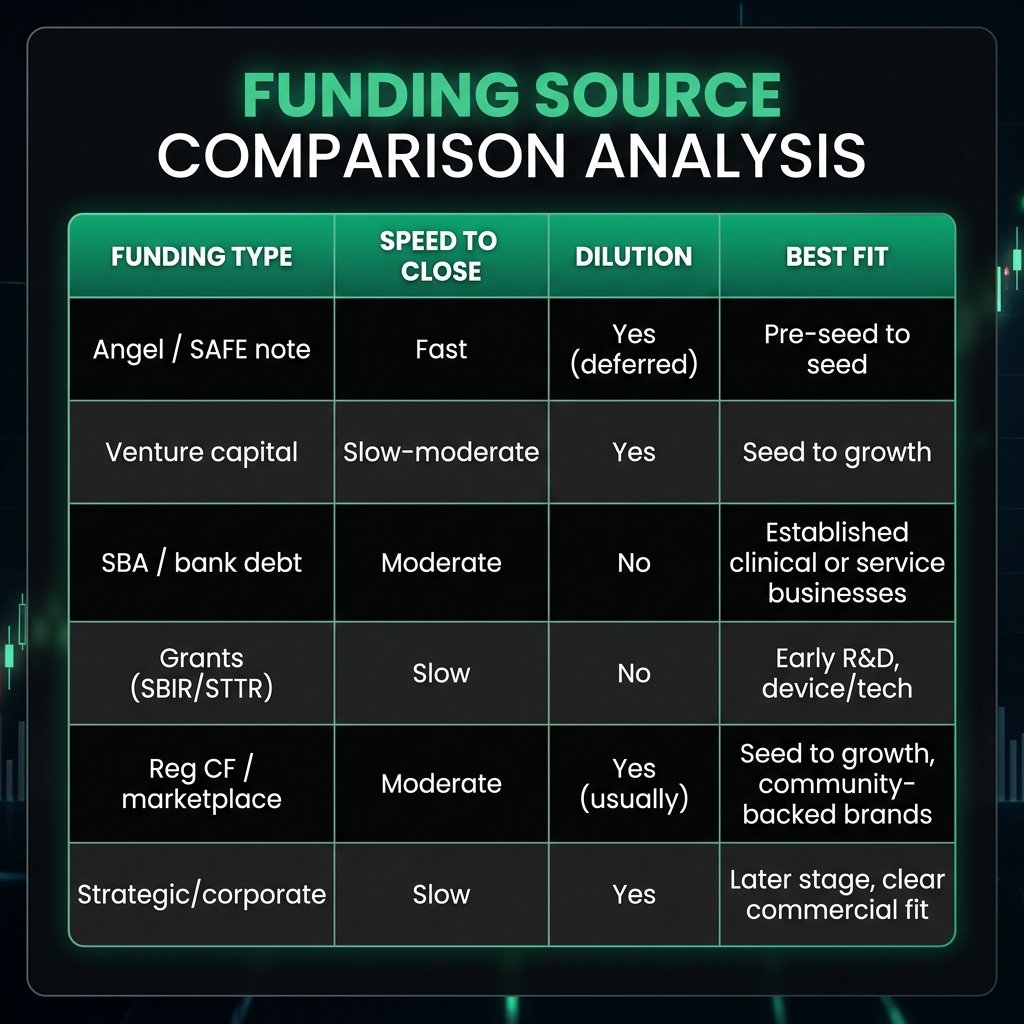
Most healthcare founders don't have a shortage of good funding options — they have a shortage of visibility with the right investors.
How to Decide Which Funding Path Fits Your Healthcare Business
A few questions to work through before you pick a path:
Do you have R&D that isn't yet commercial? Grants may be worth pursuing before you give up equity.
Do you need capital fast to hit a near-term milestone? Angels and SAFE notes typically close faster than venture rounds or bank loans.
Is your business generating revenue already? Debt financing may let you avoid dilution entirely.
Do you need investors who understand healthcare specifically? This is where getting in front of the right audience matters more than the instrument itself — see Funding My Venture's funding solutions for a breakdown of how the platform supports different raise types.
Next Step: List Your Healthcare Business on Funding My Venture
Most healthcare founders don't have a shortage of good funding options — they have a shortage of visibility with the right investors. Once you know which type of capital you're after, the next step is getting your raise in front of people actually looking for it. Read the full 2026 guide to where you can find investors for your business for a deeper look at investor sourcing beyond the funding type itself.
Ready to raise capital for your healthcare business? Explore funding solutions or browse startups currently raising on Funding My Venture.