
The Complete Guide to Commercial Land Loans and Land Development Financing in 2026

A commercial land loan is unlike a commercial construction loan in almost every underwriting dimension.
Every commercial building starts as an idea on a piece of paper and a piece of land that isn't yet ready to hold it.
Between those two points sits one of the least understood — and least forgiving — corners of commercial real estate finance: land loans, land development capital, and the eventual land construction loan bridge into vertical construction. This is the second installment in our 15-part series on commercial construction financing (the first, How Commercial Developers Can Secure a Builder Construction Loan in 2026, covers the vertical construction loan itself). This piece goes back a step further, to the ground everything else gets built on.
Land financing is, structurally, the riskiest capital a developer will ever raise. There's no rent roll, no completed improvement, sometimes not even final zoning approval — just a parcel, a plan, and a sponsor's ability to execute. That risk profile is exactly why land deals are the hardest to place with a traditional bank and why an entire specialty lending ecosystem has grown up around them. Understanding how that ecosystem works — and how to move a raw parcel through acquisition, entitlement, and horizontal development without running out of runway — is the difference between a project that breaks ground on schedule and one that stalls in year two.
Why Land Financing Is Different From Every Other Commercial Loan
A commercial land loan is unlike a commercial construction loan in almost every underwriting dimension. When a lender finances vertical construction, they're financing a defined, permitted, engineered structure with a clear completion date and — ideally — a lease or pre-sale attached. When a lender finances land, they're financing potential. That potential can evaporate: entitlements can be denied, environmental issues can surface, utility capacity can fall short, or market conditions can shift before the parcel is ever shovel-ready.
Because of that, land lenders price and structure deals more conservatively across the board:
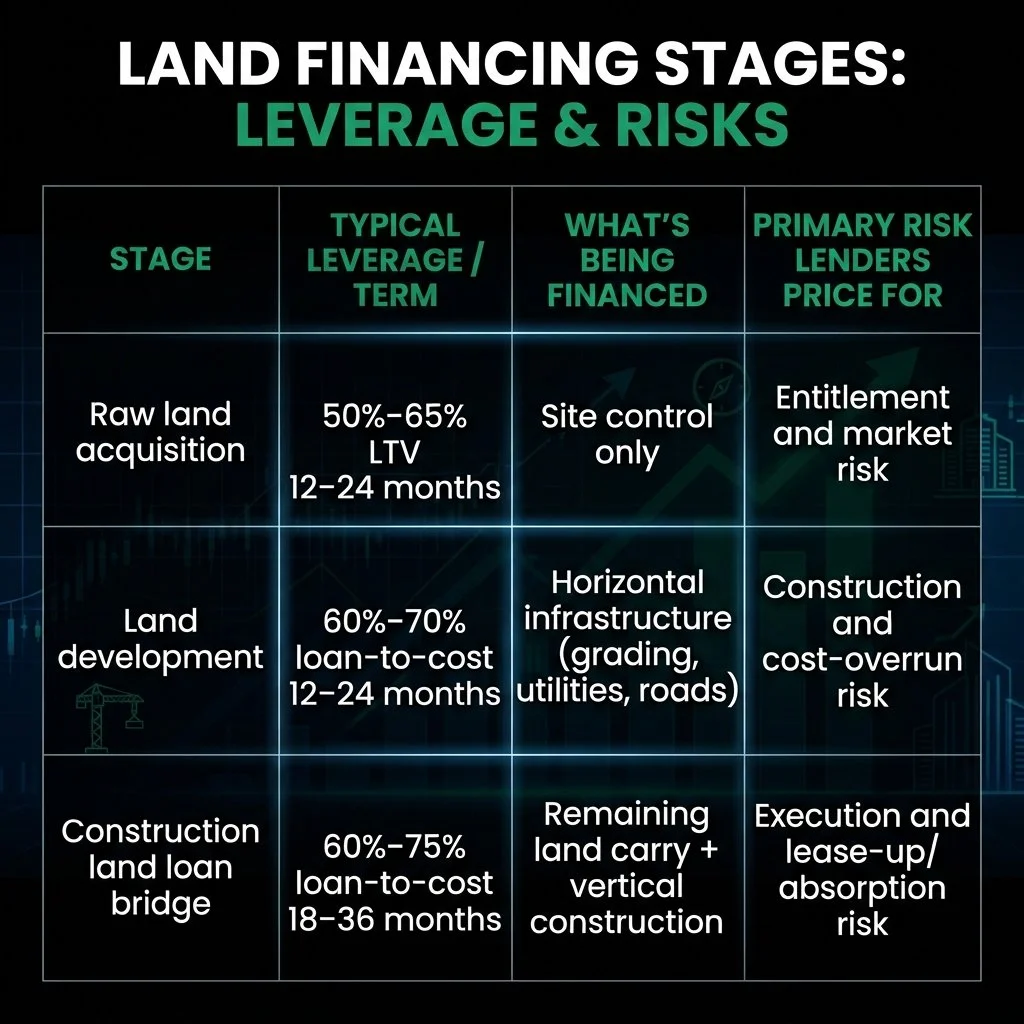
Lower leverage. Raw land acquisition loans typically max out at 50%–65% loan-to-value, compared to 60%–75% loan-to-cost on vertical construction.
Shorter terms. Land loans are often 12–24 months, reflecting the lender's discomfort holding undeveloped collateral for long stretches.
Higher rates and points. Expect a meaningful spread over both a builder construction loan and a permanent commercial mortgage, since the lender is compensated for holding illiquid, non-income-producing collateral.
More personal guarantees. Non-recourse land debt is rare outside of the largest, most experienced institutional land bankers.
None of this means land can't be financed — it means it has to be financed with the right kind of capital, structured in the right sequence, by a developer who understands exactly what stage their parcel is in.
The Three Stages of Land Financing
Almost every ground-up commercial or industrial project moves through three distinct financing stages before vertical construction financing ever enters the picture. Treating them as one undifferentiated "land loan" is one of the most common mistakes first-time developers make.
Stage 1: Raw Land Acquisition
This is simply the capital required to control the parcel — either through outright purchase or, more commonly among experienced developers, an option or purchase-and-sale agreement that ties up the site while due diligence and entitlement work proceed. At this stage, a land loan is priced almost entirely on the strength of the sponsor and the exit plan, because there's essentially nothing else to underwrite.
Due diligence at this stage typically includes:
A Phase I Environmental Site Assessment, following the process outlined by the U.S. Environmental Protection Agency, to identify any contamination risk before capital is committed
A boundary and topographic survey
Preliminary zoning and land-use review with the local planning authority
A utility availability study — water, sewer, power, and, increasingly for industrial construction sites, natural gas and high-capacity electrical service
Many developers avoid a full commercial land loan at this stage entirely, instead using an option agreement or a small earnest-money-secured note to control the site while they pursue entitlements — preserving capital for the more expensive development stage that follows.
Stage 2: Entitlement and Land Development
Once site control is secured, the parcel typically needs entitlement — rezoning, subdivision approval, or a conditional use permit — before it can be built on as intended. This stage is where land development financing comes in, funding the horizontal infrastructure that turns raw acreage into a shovel-ready pad: grading, roads, stormwater management systems, and utility extensions.
Land development loans are underwritten closer to a construction loan than a raw land loan, because there's now an engineered scope of work with defined costs — but lenders still discount aggressively for entitlement risk. A parcel with entitlements already approved is a fundamentally different, and more financeable, asset than one where approval is still pending.
This is also the stage where the professional team matters most. A qualified civil engineer or civil engineering firm produces the grading, drainage, and utility plans that both the permitting authority and the lender will scrutinize, while an engineering company with structural and geotechnical expertise identifies soil conditions that could affect foundation design and cost. Getting this work wrong — or rushing it to save time — is one of the most common causes of land development budget overruns.
Stage 3: The Construction Land Loan Bridge
Once entitlements are secured and horizontal infrastructure is complete, the parcel transitions into vertical construction. This is where a land construction loan or construction land loan structure becomes valuable: rather than refinancing the land debt separately and then originating a brand-new construction loan, many lenders will structure a single facility that rolls remaining land carry costs into the vertical construction loan.
This blended structure has real advantages:
One closing instead of two, reducing legal and origination costs
A single lender relationship managing the full project lifecycle from dirt to delivery
Continuity in underwriting, since the lender that financed the land development already understands the site's specific risk profile
Developers should raise this structure proactively with their lender during the land development phase, rather than waiting until entitlements are complete — the earlier a lender understands the intended vertical use, the more efficiently they can pre-underwrite the transition.
Who's Actually Lending on Land in 2026
Traditional banks have never been the primary source of raw land capital, and that's even more true in 2026's tighter regulatory environment. The active lenders in this space fall into a few distinct categories:
Community and regional banks — still active, but almost exclusively for well-capitalized, relationship-based borrowers with a demonstrated local track record.
Credit unions — an increasingly important source of land and land development capital for smaller commercial and industrial parcels, particularly in secondary and tertiary markets.
Private credit and debt funds — the fastest-growing source of land financing since 2023, willing to underwrite entitlement risk that banks generally won't touch, at a higher cost of capital.
Seller financing — still common on smaller commercial land loan deals, particularly when the seller is a landowner rather than an institutional entity.
SBA 504 and related programs — for owner-occupied projects, the U.S. Small Business Administration's 504 loan program can be a useful tool for business owners acquiring land to build their own facility, though it's less applicable to pure investment/development plays.
Developers should approach land financing the same way they approach vertical construction financing: with multiple lender relationships in parallel, not a single application submitted and hoped for. The Urban Land Institute has noted that land banking and entitlement capital remain among the least standardized corners of real estate finance, meaning terms vary widely between lenders — which makes comparison shopping unusually valuable.
Industrial and Mixed-Use Land: Two Cases Worth Separating
Not all land is underwritten the same way, and two categories deserve specific attention because they represent a growing share of 2026's development pipeline.
Industrial land — parcels suited for distribution, manufacturing, or cold storage — has held its value and financeability better than almost any other land category through the recent lending contraction. An industrial contractor or industrial builder evaluating a site for a client, or a developer controlling land for a future industrial build, should factor rail access, highway proximity, and power capacity into the earliest due diligence, because these factors drive both entitlement feasibility and eventual lender appetite far more than they do for other property types.
Mixed-use land presents the opposite challenge: greater complexity, but also greater flexibility. A mixed use developer controlling a parcel zoned or entitled for a blend of retail, residential, and office uses has more optionality if market conditions shift during the entitlement process — but also faces a more complicated approval path, since mixed-use zoning changes typically require more extensive community and planning-commission review than a single-use rezoning. Developers pursuing mixed-use land should budget extra time and legal capital for this process and communicate that timeline honestly with lenders from the outset.
Building the Trade and Professional Team Before You Ever Break Ground
Land development financing is unusual in that most of the "construction" work is invisible once it's done — nobody drives by a shovel-ready pad and admires the stormwater engineering underneath it. But that invisible work is exactly what a lender is financing at this stage, which means the professional team assembled to do it matters enormously to the loan package.
Civil engineering firms design the grading, drainage, and utility infrastructure that makes a site buildable — and their permit-ready plans are often a prerequisite for a land development lender to release funds.
Architecture company partners, even at the land stage, help confirm that the intended building program is actually feasible on the site's dimensions, setbacks, and easements before a developer commits development capital.
Excavation company partners provide the earthwork bids that anchor the land development budget, and a bonded, locally experienced excavation contractor materially reduces a lender's perceived execution risk.
Engineering company partners handle geotechnical and structural considerations that affect both site costs and future building design.
Developers who bring signed or advanced-stage proposals from each of these partners into their land development loan application — rather than budgeting with placeholder allowances — consistently see faster underwriting and better terms, for the same reason documented trade relationships help on the vertical construction side covered in Article 1 of this series.
What Lenders Actually Review: A Land Underwriting Checklist
Because land deals lack the income statement or completed-improvement inspection that anchors most commercial underwriting, lenders compensate by scrutinizing a wider, more document-heavy set of inputs. Developers preparing a land loan or land development application in 2026 should expect a checklist that typically includes:
Title report and survey, confirming clean ownership, easements, and any encumbrances that could affect buildability
Zoning confirmation letter from the local planning authority, or a clearly documented entitlement application timeline if rezoning is still pending
Phase I Environmental Site Assessment, and a Phase II if the Phase I flags any recognized environmental conditions
Geotechnical report addressing soil bearing capacity, groundwater, and any conditions that could affect foundation design or site costs
Utility availability letters from the relevant water, sewer, electric, and gas providers confirming capacity and estimated extension costs
Preliminary site plan from a licensed civil engineer, showing grading, drainage, and general building placement
Sponsor financial statements and schedule of real estate owned, since land lenders lean more heavily on sponsor strength than almost any other loan category
Sources-and-uses budget for the specific stage being financed — acquisition, entitlement, or horizontal development — rather than a single blended number for the whole project
A developer who can produce this full package proactively, rather than assembling it piecemeal as a lender requests each item, typically shaves weeks off the underwriting timeline. Lenders read an organized, complete package as a signal of sponsor competence — which matters more in land lending than almost anywhere else in commercial real estate finance, precisely because there's so little else to underwrite against.
Land Loan Stages at a Glance
Construction contractor funding and construction contractor financing aren't limited to vertical builders; earthwork and infrastructure contractors working land development phases often need the same kind of mobilization and payroll-bridging capital between draws.
Reading down this table is, in effect, a map of how risk migrates over the life of a development project — from pure speculation on entitlement outcomes, to construction execution risk, to eventual market and leasing risk once the building is delivered. Structuring capital deliberately at each stage, rather than trying to finance the whole arc with a single loan from day one, is what allows developers to access the lowest reasonable cost of capital at every point along the way.
Frequently Asked Questions on Commercial Land Financing
Can I get a land construction loan with no entitlements in place? It's difficult. Most lenders offering a blended land construction loan or construction land loan structure want to see entitlements at least substantially complete before committing to the vertical construction portion, even if they're willing to fund horizontal development work earlier.
How much cash equity do I need to put into a land deal? Expect to fund 35%–50% of a raw land acquisition and a meaningful share of land development costs out of equity or subordinate debt, given the conservative leverage most senior land lenders will extend in 2026's underwriting environment.
Is seller financing still available for commercial land? Yes, particularly for smaller parcels and non-institutional sellers. Seller-financed land deals can offer more flexible terms than institutional lenders, though they still typically require a meaningful down payment and a market-rate note.
What happens if my land loan matures before entitlements are complete? This is one of the most common — and most avoidable — sources of developer distress. Extension options should be negotiated into the original loan terms wherever possible, and developers should start refinance or extension conversations at least 90 days before maturity rather than waiting for a default notice.
Common Land Financing Mistakes That Stall Projects
A few recurring mistakes account for a disproportionate share of stalled or failed land deals:
Underestimating entitlement timelines. Zoning and permitting processes routinely take longer than developers project, and land loans with short maturities can come due before entitlements are even secured.
Skipping environmental due diligence to save time or money. A Phase I (and, where warranted, Phase II) environmental assessment is inexpensive relative to the cost of discovering contamination after acquisition.
Underfunding horizontal infrastructure. Utility extensions, in particular, are a frequent source of budget overruns — running water and sewer lines to a remote parcel can cost far more than developers initially estimate.
Waiting too long to plan the construction land loan transition. Developers who wait until entitlements are essentially complete to start conversations about the vertical construction takeout routinely lose months to a fresh underwriting process that could have started earlier.
Treating land loans like construction loans. Applying the same draw-schedule and documentation expectations to a land deal that has none of the defined milestones of vertical construction leads to friction with lenders unfamiliar with the specific parcel's entitlement status.
Financing the Rest of the Ecosystem: Contractors and Equipment
Land development work — grading, utility installation, road construction — is itself performed by contractors who have their own capital needs. Construction contractor funding and construction contractor financing aren't limited to vertical builders; earthwork and infrastructure contractors working land development phases often need the same kind of mobilization and payroll-bridging capital between draws.
Similarly, construction equipment funding and construction equipment financing play an outsized role at the land development stage specifically, since heavy earthmoving equipment — graders, excavators, compactors — represents a disproportionate share of a land development contractor's capital needs relative to the finish-trade equipment used later in vertical construction. This is a distinct category within equipment financing broadly, and developers vetting an excavation or land development contractor should ask directly about their equipment financing arrangements as part of assessing execution risk.
From Land to Building: Setting Up the Next Financing Stage
The entire point of financing land correctly is to set up a clean, efficient transition into vertical construction. Developers who get this sequence right typically follow a consistent pattern:
Secure site control with the least expensive capital available — an option agreement where possible, a modest acquisition loan where necessary.
Complete environmental, survey, and utility due diligence before committing significant development capital.
Engage civil engineering, architecture company, and geotechnical engineering company partners early enough that their findings shape the entitlement application rather than following it.
Pursue entitlements with a realistic timeline communicated clearly to any land lender.
Structure land development financing to fund horizontal infrastructure with firm, bonded contractor bids rather than budget allowances.
Begin construction lender conversations for the vertical new construction loan or land construction loan bridge well before entitlements and horizontal work are finished — not after.
Use the resulting shovel-ready, entitled parcel as leverage for better vertical construction financing terms, since a fully de-risked site is a materially stronger loan package than raw land with a business plan attached.
Where to Find Land and Development Capital in 2026
Because land financing sits outside the comfort zone of most traditional banks, developers benefit disproportionately from platforms that connect them directly to a wider pool of private lenders and investors who specifically understand entitlement and development risk. Funding My Venture's Funding Solutions page outlines the specific capital structures available across the land-to-building lifecycle, and the Investor Hub connects developers directly with capital sources actively looking to fund land development, land construction loan bridges, and the vertical builds that follow.
For a broader look at how developers are sourcing capital relationships across the entire project lifecycle — not just at the land stage — the 2026 Guide: Where Can I Find Investors for My Business is a useful companion piece, and Why Business Owners Choose Funding My Venture explains the platform's approach in more depth. Developers interested in the community aspect of the platform — connecting with other operators navigating the same land-to-building process — can also read Why Funding My Venture Is the Best Online Community for Founders and Entrepreneurs.
The platform's businesses marketplace and its Construction category also feature vetted infrastructure and civil contracting operators actively working the land development and site-work side of the business — including companies like Apex Civil Infrastructure and Summit Infrastructure Contractors, both of which represent the kind of civil and infrastructure execution partners developers need at the land development stage, and NextGen Modular Builders, whose modular construction approach can meaningfully shorten the gap between shovel-ready land and a delivered building.
Land Financing and the Broader Commercial Property Market
It's worth remembering that land financing doesn't happen in a vacuum — it happens against the backdrop of an active commercial real estate market where owners are simultaneously buying, selling, and leasing improved property. A developer scanning listings for commercial property for sale or evaluating a parcel adjacent to a property already on the market for commercial property for lease should factor that surrounding activity into their entitlement and use-case planning, since local absorption trends often shape what a planning commission — and a lender — will consider a realistic highest-and-best use for a given site.
This is also why developers who eventually need to sell my property, sell my building, or move an asset through a sell my property fast timeline benefit from having started with clean land-stage documentation. Title issues, unresolved easements, or incomplete entitlement records surface again at disposition, often years after the original land loan closed, and they can meaningfully slow a sale or a building owner refinance long after the development itself is complete. Treating land-stage paperwork as a permanent part of the asset's record — not a box to check and forget — pays off well beyond the construction period.
The developers who move fastest through this stage in 2026 treat land financing as its own discipline rather than an afterthought before "the real construction loan."
The Bottom Line on Land Financing in 2026
Land financing will always be the hardest capital to raise in commercial real estate, because it's the stage with the least certainty and the longest runway before any income is generated. But that difficulty is also where developers can build the most durable competitive advantage — a well-entitled, properly financed, shovel-ready parcel is worth meaningfully more than raw acreage with a business plan attached, and it dramatically improves every subsequent financing conversation, from the vertical commercial construction loan through building owner refinance years later.
The developers who move fastest through this stage in 2026 treat land financing as its own discipline rather than an afterthought before "the real construction loan." They sequence their capital correctly across acquisition, entitlement, and horizontal development; they bring a documented professional and trade team into the process early; and they start the conversation about their vertical construction takeout long before they actually need it.
This series continues in Article 3 with a deep dive into NNN construction loan and NNN construction financing structures — how build-to-suit deals get underwritten on tenant credit rather than market speculation, and why triple-net product has become one of the most financeable categories in commercial real estate. In the meantime, explore the Construction category on Funding My Venture to see the civil, infrastructure, and modular building partners already active on the platform.