
How to Find Off-Market Hotels For Sale Before They Hit the Market

To build a reliable sourcing engine, you must first understand why a hotel owner or institutional hotel seller would choose a private, unlisted transaction over a broad public marketing campaign.
In the highly competitive commercial hospitality sector, the best investment opportunities are rarely advertised publicly. While mainstream buyers comb through public online portals, institutional syndicates, private equity firms, and sophisticated family offices quietly execute transactions behind closed doors. In fact, in 2026, a substantial portion of premium hospitality transaction volume occurs entirely off-market.
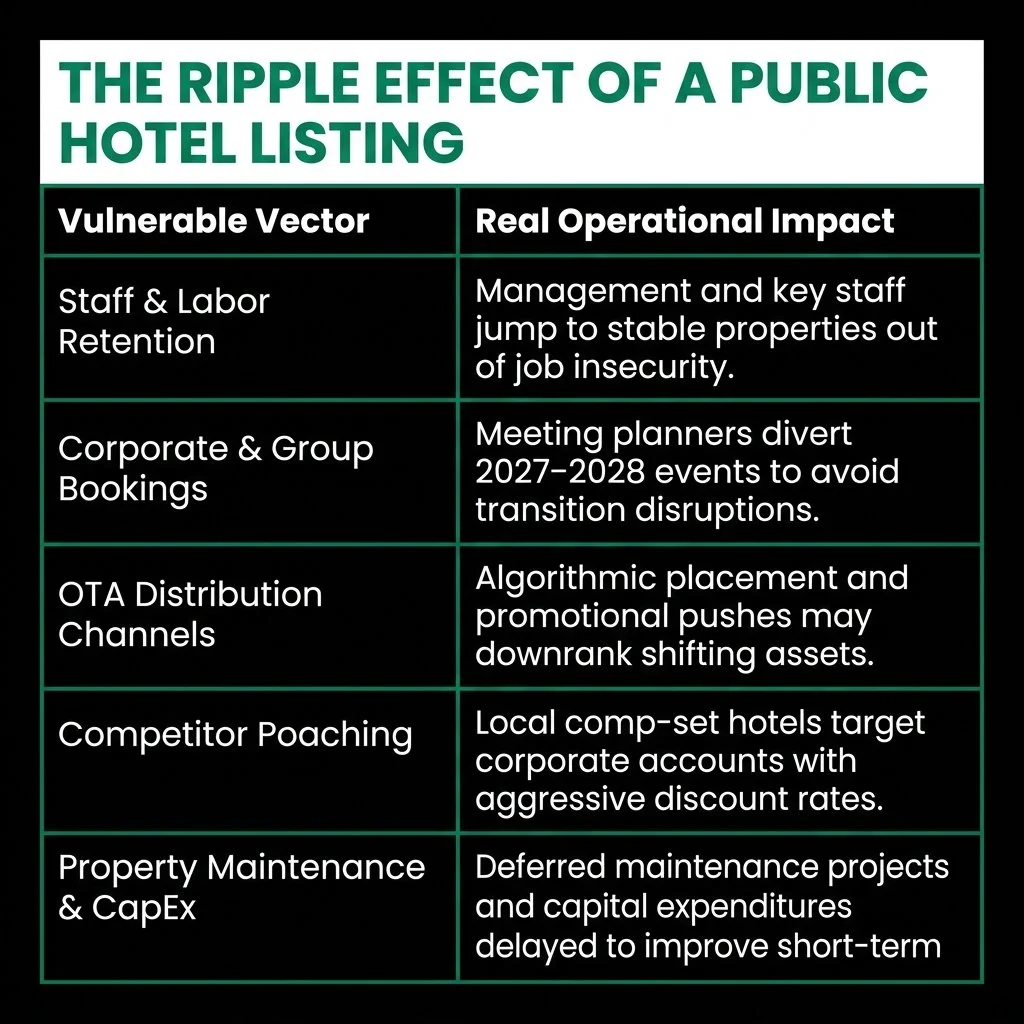
When a property is openly listed, it triggers aggressive bidding wars that compress capitalization rates and push valuations to a premium. Furthermore, a public listing can disrupt operations by signaling transition to employees, competing properties, and online travel agencies (OTAs). For an institutional hotel buyer, mastering the mechanics of sourcing off-market hotels for sale is a vital strategy for acquiring high-yield assets below replacement cost.
Whether you are an established hotel investor, a growing private equity fund, or an expanding regional hospitality operator, this guide outlines the proactive deal-sourcing framework required to find, underwrite, and close off-market hotels for sale before they reach the broader market.
1. Why the Best Deals in the Hospitality Industry Stay Off-Market
To build a reliable sourcing engine, you must first understand why a hotel owner or institutional hotel seller would choose a private, unlisted transaction over a broad public marketing campaign. Unlike traditional commercial real estate asset classes—such as net-leased retail or industrial warehouses—hotels are dynamic, operational daily-lease businesses.
Top-tier commercial hospitality brokers handle a significant volume of private transactions. These are often referred to as "pocket listings" or "quiet market deals".
Because public knowledge of a pending sale can negatively impact a property's performance, many institutional sellers prefer direct, confidential discussions. This dynamic allows an opportunistic hotel buyer to negotiate directly with principals, bypass the traditional bidding process, and arrange favorable asset structures.
2. Strategic Channels for Sourcing Off-Market Hotels for Purchase
Uncovering unlisted hotels for purchase requires a proactive outbound sourcing model. Relying on basic automated listing alerts will keep you a step behind the market. Instead, focus capital and time on four institutional deal-flow channels:
1. Broker "Pocket Listings" and Exclusives
Top-tier commercial hospitality brokers handle a significant volume of private transactions. These are often referred to as "pocket listings" or "quiet market deals". Brokers share these opportunities exclusively with a highly curated list of verified buyers who have a clear track record of closing. To access this inner circle, you must demonstrate financial capability, clear investment parameters, and immediate liquidity.
2. Direct-to-Owner Data Sourcing Campaigns
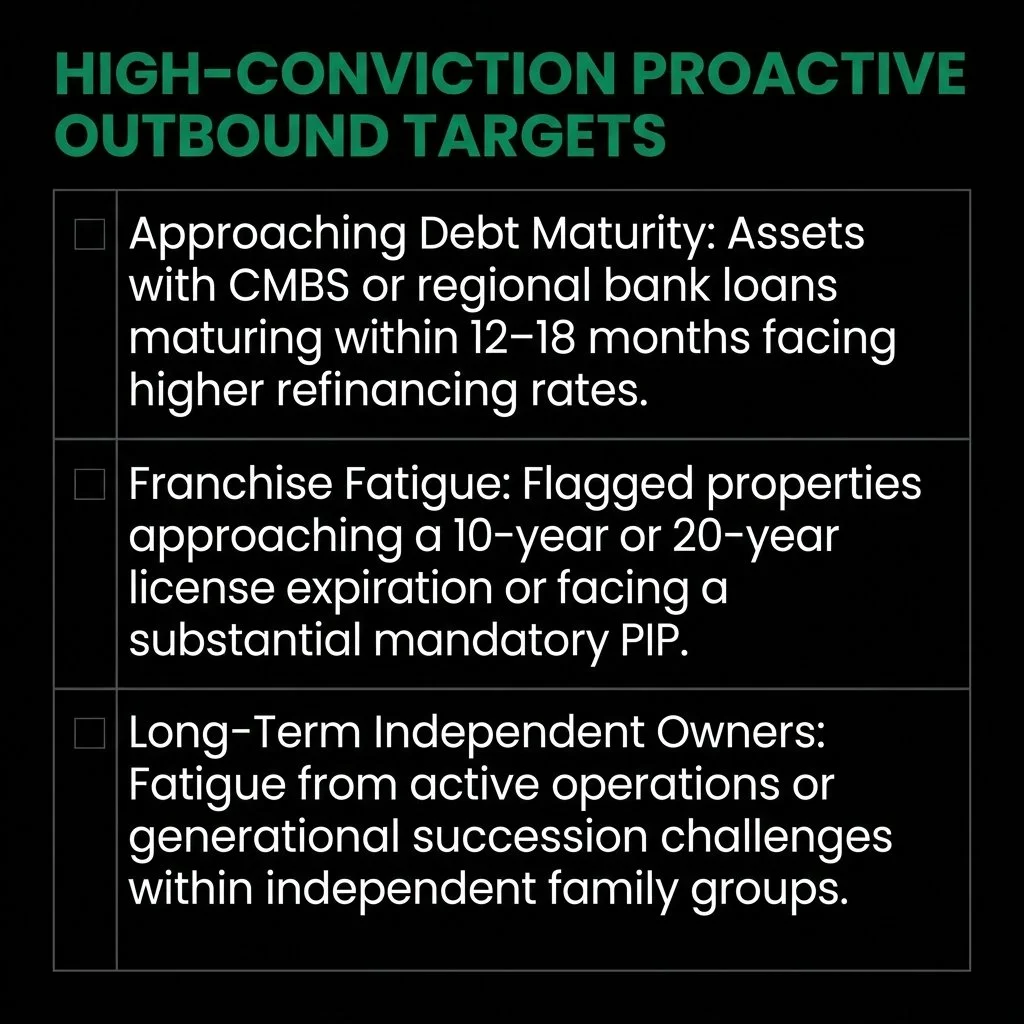
Rather than waiting for a broker introduction, institutional buyers launch direct marketing and cold-calling campaigns targeted at specific property profiles. By utilizing specialized hospitality data platforms (such as STR reports, CoStar, or county property records), you can identify assets that meet your specific investment parameters.
Sourcing high-yielding real estate requires deep local market intelligence.
3. Monitoring Macro Stress: Foreclosures and Note Sales
Operational or structural capital distress often forces ownership transitions before a public listing occurs. Savvy buyers regularly monitor special servicer reports and bankruptcy filings to identify properties facing refinancing hurdles. For a detailed breakdown of how to find and acquire distressed or lender-owned assets, refer to our comprehensive companion guide: How to Find Hotel Foreclosure Listings For Sale.
4. Regional Sourcing Frameworks
Sourcing high-yielding real estate requires deep local market intelligence. If you are target-marketing specific geographical regions, utilize our localized analytical overviews to map out market demand generators, tax landscapes, and historical RevPAR data:
3. Underwriting an Off-Market Deal: How Much Does It Cost to Buy a Hotel?
When analyzing an off-market opportunity, you are frequently working with raw, un-audited operational data provided directly by the owner. Unlike public listings backed by a polished broker offering memorandum (OM), direct-to-owner deals require forensic financial underwriting.
To evaluate how much does it cost to buy a hotel off-market, your underwriting team must verify the property's underlying performance metrics without market comps:
True Capitalization Rate = Audited Net Operating Income (NOI) / Purchase Price + Immediate Capital Expenditures (CapEx) + Brand PIP Costs
Forensic Financial Due Diligence Protocol
Verify STR Report Authenticity: Cross-reference the owner's stated room revenues with their official historical Smith Travel Research (STR) reports to confirm market occupancy, Average Daily Rate (ADR), and RevPAR penetration index.
Normalize the Income Statement: Review the Trailing-12 (T12) P&L to isolate personal owner expenses, discretionary family distributions, or artificially deferred maintenance costs that could misrepresent stabilized operational overhead.
Assess the True Cost of Capital: Factor in current macroeconomic variables, regional labor availability, and updated debt pricing when calculating your projected internal rate of return (IRR).
4. Financing Off-Market Acquisitions: Structuring Capital Teams
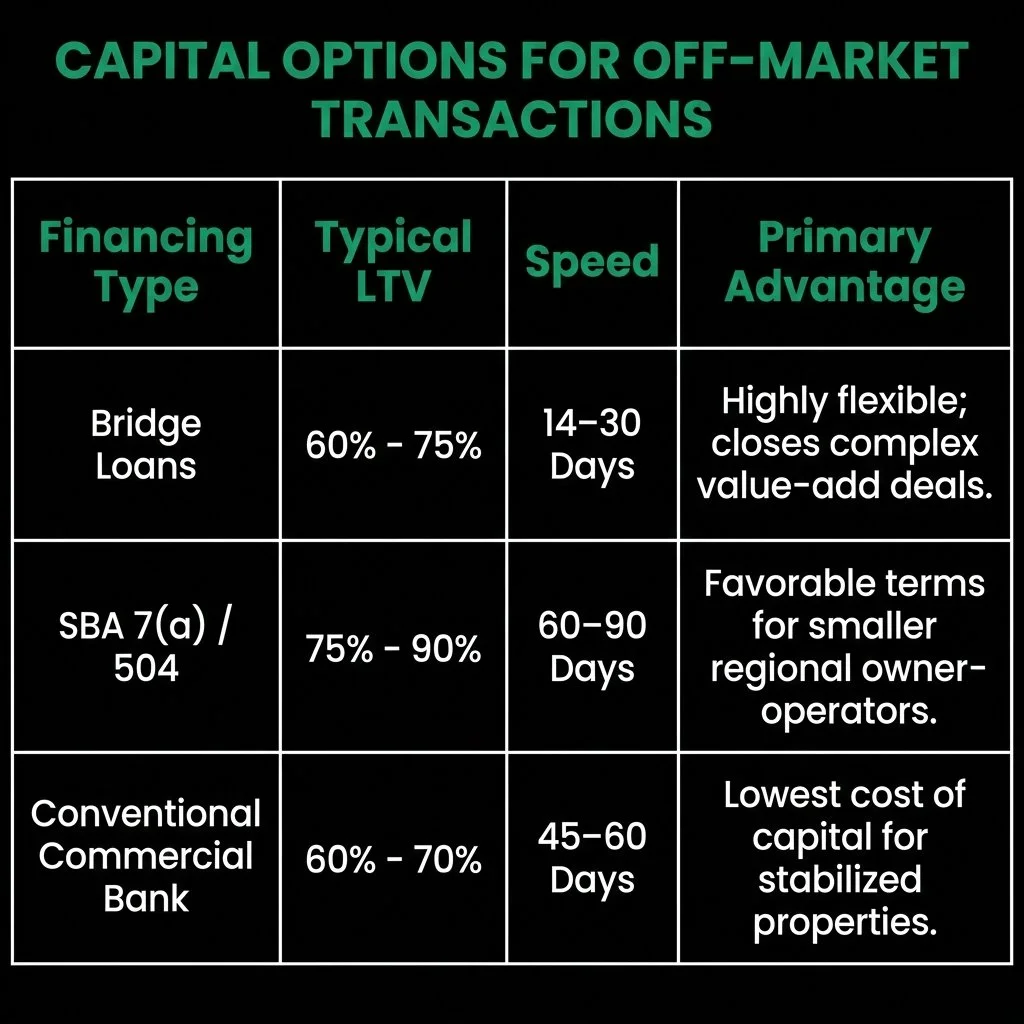
Securing competitive hotel purchase financing is a critical step when navigating an off-market transaction. Because unlisted transactions often feature shorter closing windows or complex operational structures, having a pre-arranged capital stack provides a significant competitive advantage.
Utilize commercial databases to build a clean property contact list.
Off-market opportunities often allow for more creative financing arrangements. For instance, if an owner wants to transition out of daily operations but limit immediate capital gains taxes, a hotel buyer can negotiate a structured installment sale or a partial seller-carryback note.
To align your portfolio with competitive, flexible institutional lending terms, explore active capital deployment strategies through Funding Solutions.
5. Step-by-Step Guide to Direct-to-Owner Off-Market Sourcing
Executing an effective outbound sourcing strategy requires a disciplined, programmatic workflow:
1.Define Target Parameters & Build Property Lists: Utilize commercial databases to build a clean property contact list.
Identify your target market scale, asset class preference (select-service, extended-stay, or boutique), and geographic footprint. Compile ownership contact details, corporate entity filings, and debt profiles via public land records.
2.Execute Direct Principal Outreach: Deploy personalized, professional outreach campaigns directly to principals.
Reach out directly to owners via tailored direct mail campaigns or direct professional channels. Frame your message as a well-capitalized, principal buyer capable of structuring a quiet, friction-free transaction.
3.Secure the Confidential Data Room: Execute non-disclosure agreements to unlock historical financials.
Once an owner expresses interest in a potential transaction, sign a strict Non-Disclosure Agreement (NDA). Request 3 years of audited tax returns, the most recent T12 P&L statement, utility summaries, and current STR reports.
4.Underwrite Performance Metrics & Submit LOIs: Model pro forma scenarios incorporating deferred maintenance and PIPs.
Model the property's financial performance under stabilized management. Submit a formal Letter of Intent (LOI) outlining clear transaction timelines, earnest money terms, and necessary financing contingencies.
5.Manage Due Diligence & Secure Financing: Complete physical inspections and obtain franchisor transfers.
Coordinate structural engineering surveys, environmental assessments, and franchise license audits. Work with your lending partners to formalize loan commitments and prepare for a seamless transition.
6. Underwriting Reference Assets and Industry Deal Flow
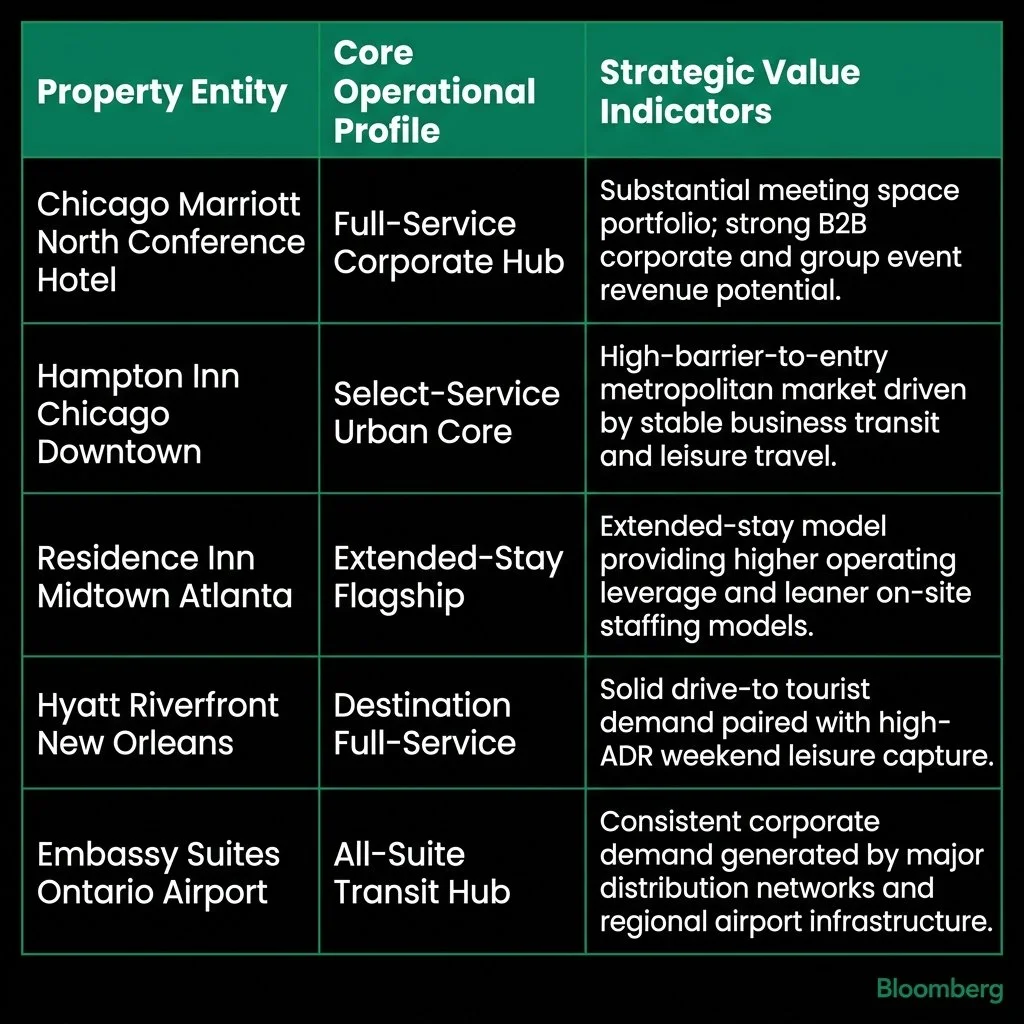
To build accurate pro forma models, successful syndicators study existing operations across various submarkets. Analyzing active portfolio benchmarks provides valuable baseline insights when evaluating unlisted hotels for sale or structuring private equity acquisitions:
Partnering with a proven third-party hospitality operator ensures that service standards, revenue management software, and marketing channels remain steady through the change of ownership.
To explore structured deal flow and review vetted hospitality opportunities, visit our active marketplace and browse listings under Funding My Venture Hospitality Businesses.
7. Navigating Property Transitions and Brand Operations
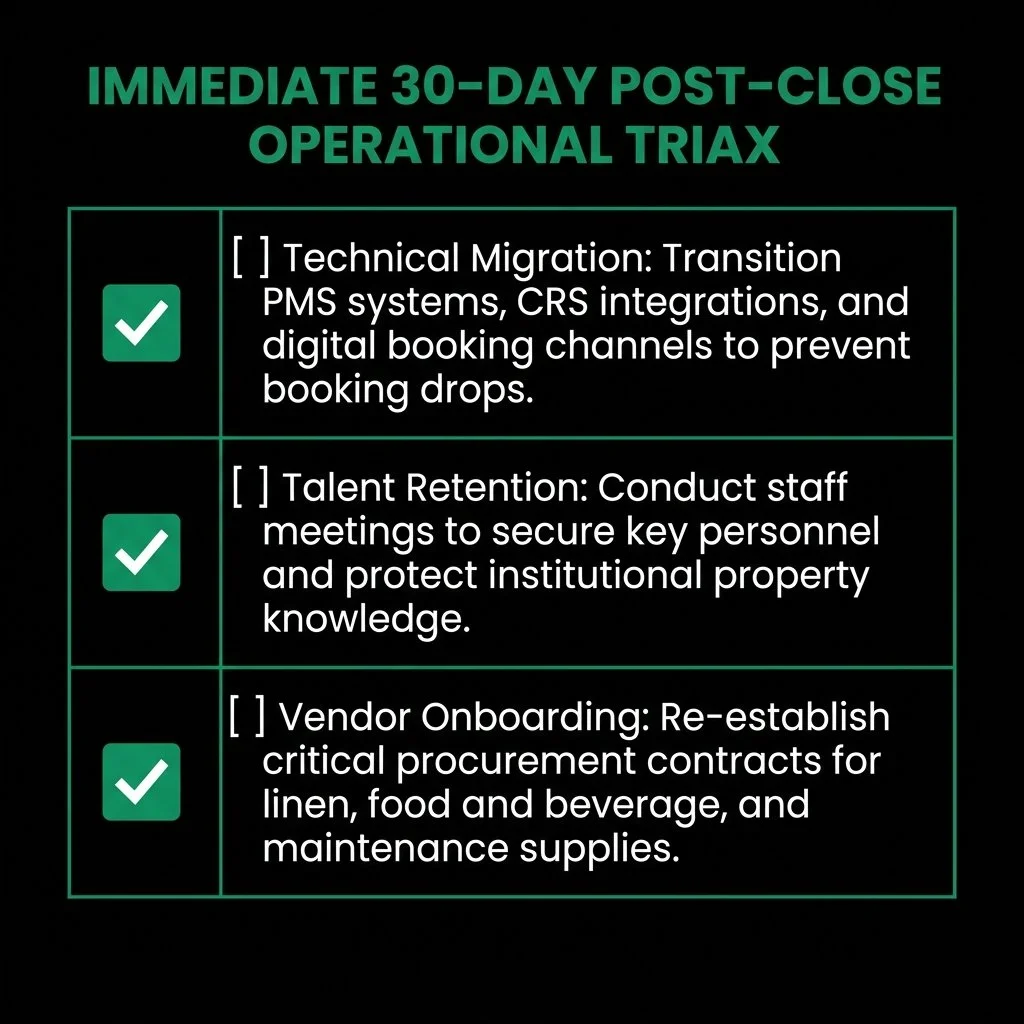
Once a private transaction closes, execution shifts to stabilizing daily operations. Private off-market deals often require an immediate operational transition plan to avoid disrupting the guest experience. Partnering with a proven third-party hospitality operator ensures that service standards, revenue management software, and marketing channels remain steady through the change of ownership.
If you are ready to explore options and declare, "I am ready to sell my hotel," utilizing a private network can maximize your pricing power while safeguarding your business.
For investment groups seeking to align equity with vetted, high-conviction syndicates, specialized groups like Summit Hospitality Capital provide access to collaborative joint-venture frameworks.
8. The Disposition Lifecycle: Selling an Off-Market Asset
If you are a hotel investor managing an existing portfolio and considering a liquidity event, selling via a confidential off-market process can protect your property's net operating income (NOI) throughout the transaction lifecycle.
Knowing how to sell a hotel privately allows a hotel owner to clear their portfolio without inviting public scrutiny or risking employee turnover. When a hotel sold private equity or family office transaction is executed quietly, it preserves brand equity and operational momentum right up to the closing date. If you are ready to explore options and declare, "I am ready to sell my hotel," utilizing a private network can maximize your pricing power while safeguarding your business.
9. The Funding My Venture Sourcing Advantage
Finding and capitalizing on premium, off-market opportunities requires advanced market intelligence, data infrastructure, and direct access to active capital partners.

Knowing how to sell a hotel privately allows a hotel owner to clear their portfolio without inviting public scrutiny or risking employee turnover.
To learn more about how our platform creates value for developers, syndicates, and equity partners, read our full platform overview: Why Business Owners Choose Funding My Venture.
If you are an accredited investor, institutional allocator, or qualified buyer seeking access to off-market hospitality inventory, join our platform via the Funding My Venture Investor Hub.
10. Summary Checklist for Sourcing Off-Market Hotels
Protect Asset Value: Leverage private sourcing channels to protect property performance and staff stability from public listing disruption.
Engage Elite Brokers: Build trust with regional commercial brokers to gain early access to pocket listings and off-market exclusives.
Conduct Forensic Underwriting: Audit unlisted financial documentation thoroughly, making sure to account for upcoming debt maturities and franchise PIPs.
Structure Capital in Advance: Secure flexible debt and co-investment capital to demonstrate financing certainty to sellers.