
How to Secure Startup Venture Cash Advance Financing
By Wall Street & Middle-Market Deal Desk
Bloomberg Deals Special Report — M&A & Private Equity
The venture cash advance and the specialized merchant cash advance for startups have transformed from niche liquidity tools into primary financial instruments within modern corporate treasury strategy.
1. The Modern Capital Stack: The Macro Shift Toward Non-Dilutive Liquidity
Over the past decade, the global corporate capital stack for technology enterprises has undergone a structural transformation. In earlier funding cycles, an emerging startup seeking multi-million-dollar expansion capital faced a binary choice: dilute founder equity through institutional venture capital (VC) rounds or attempt to qualify for traditional startup business loans from commercial banks that demanded physical collateral, personal guarantees, and multi-year positive cash flow histories.
Today, macroeconomic shifts—characterized by fluctuating central bank interest rates, tightened underwriting protocols at regional banks, and institutional valuation pullbacks—have rendered those traditional funding mechanisms either excessively costly or altogether inaccessible for early-to-mid-stage startup ventures. As founders seek ways to extend operational runway and fund aggressive customer acquisition campaigns without giving away equity at compressed valuations, alternative financial engineering models have surged to the forefront of executive decision-making.
Among these mechanisms, the venture cash advance and the specialized merchant cash advance for startups have transformed from niche liquidity tools into primary financial instruments within modern corporate treasury strategy.
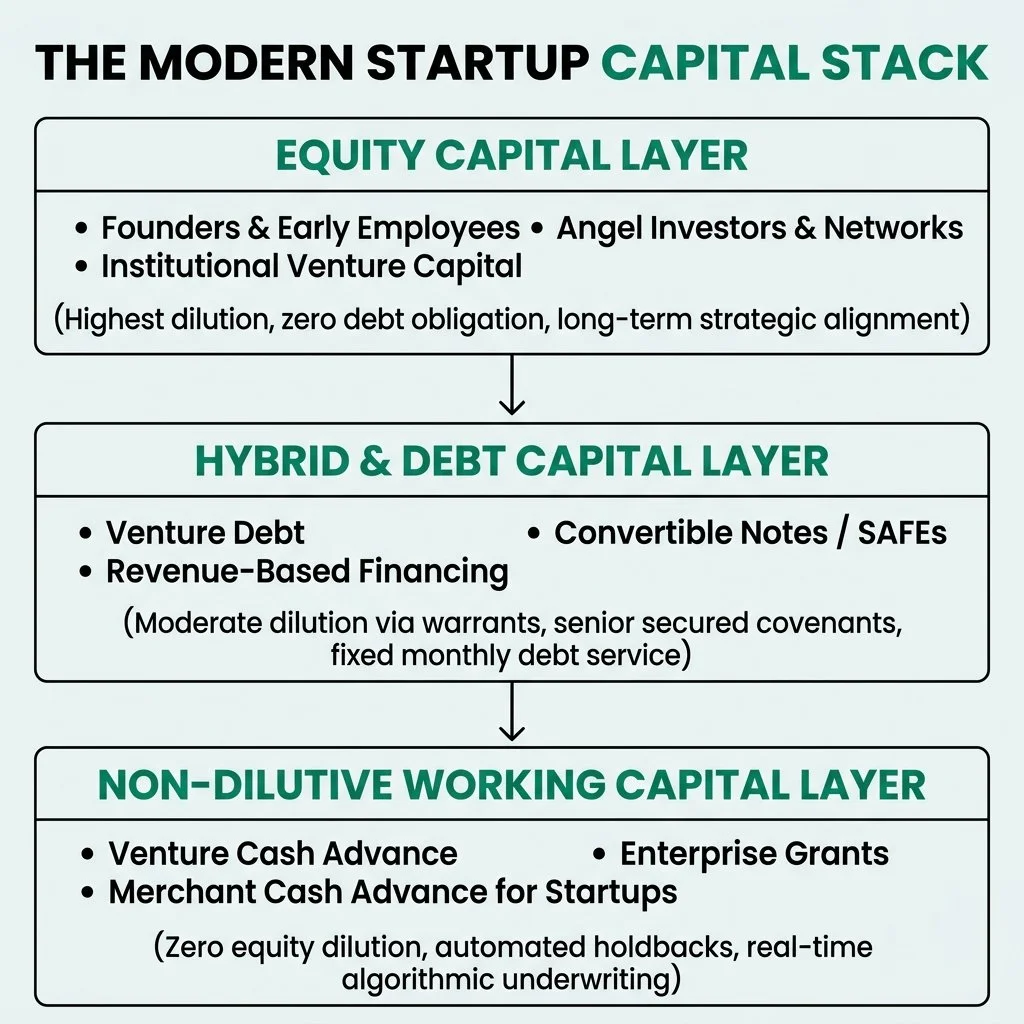
Non-dilutive liquidity through a start up business cash advance allows executives to fund inventory runs, server scaling, or digital marketing pushes while preserving cap-table ownership ahead of higher-valuation priced equity rounds.
Historically, conventional merchant cash advance for start up business models were perceived as emergency financing mechanisms reserved for cash-strapped retail or hospitality businesses. However, modern financial technology platforms have re-engineered the mechanics of revenue advances specifically for digital enterprises, software-as-a-service (SaaS) providers, e-commerce platforms, and high-margin tech ventures.
Rather than assessing creditworthiness solely through legacy FICO scores or audited historical tax returns, algorithmic underwriting engines analyze real-time operational metrics—including daily gross merchant volume (GMV), monthly recurring revenue (MRR), customer acquisition cost (CAC) efficiency, net retention rates, and open-banking cash flows.
For founders evaluating how to fund my startup, understanding the exact balance between equity dilution and short-term capital obligations is critical. While securing equity from an angel investor or institutional startup vc provides patient balance-sheet equity, it carries a permanent cost: permanent equity dilution.
Conversely, non-dilutive liquidity through a start up business cash advance allows executives to fund inventory runs, server scaling, or digital marketing pushes while preserving cap-table ownership ahead of higher-valuation priced equity rounds.
To understand why modern corporate treasurers use these options, founders can examine why business owners choose Funding My Venture to optimize their working capital without diluting equity.
2. Decoding the Venture Cash Advance: Architecture, Underwriting, and Financial Mechanics
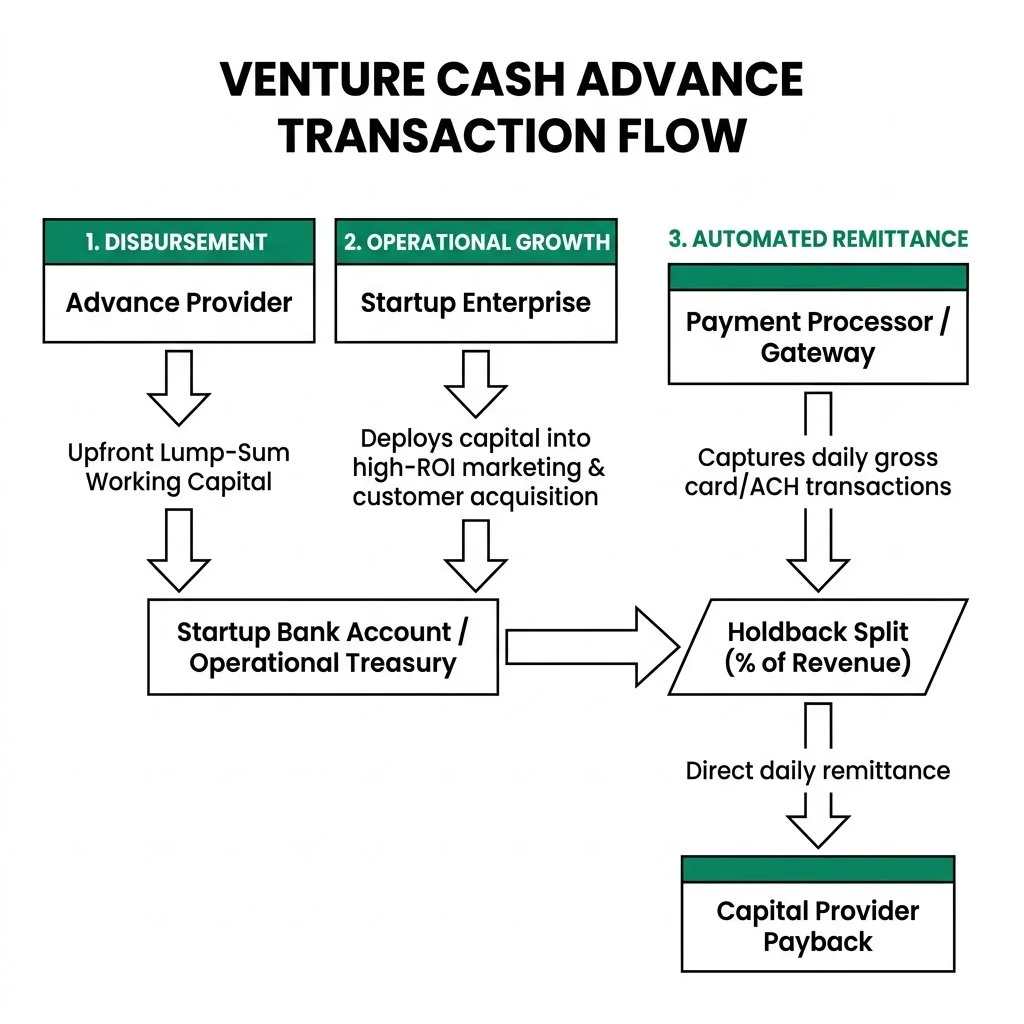
A venture cash advance is a non-dilutive commercial transaction in which a capital provider purchases a specific dollar amount of a company's future receivables at a discounted price. In exchange for an immediate lump-sum cash disbursement, the company agrees to remit a pre-determined percentage of its daily or weekly revenues until the purchased receivables total is fully satisfied.
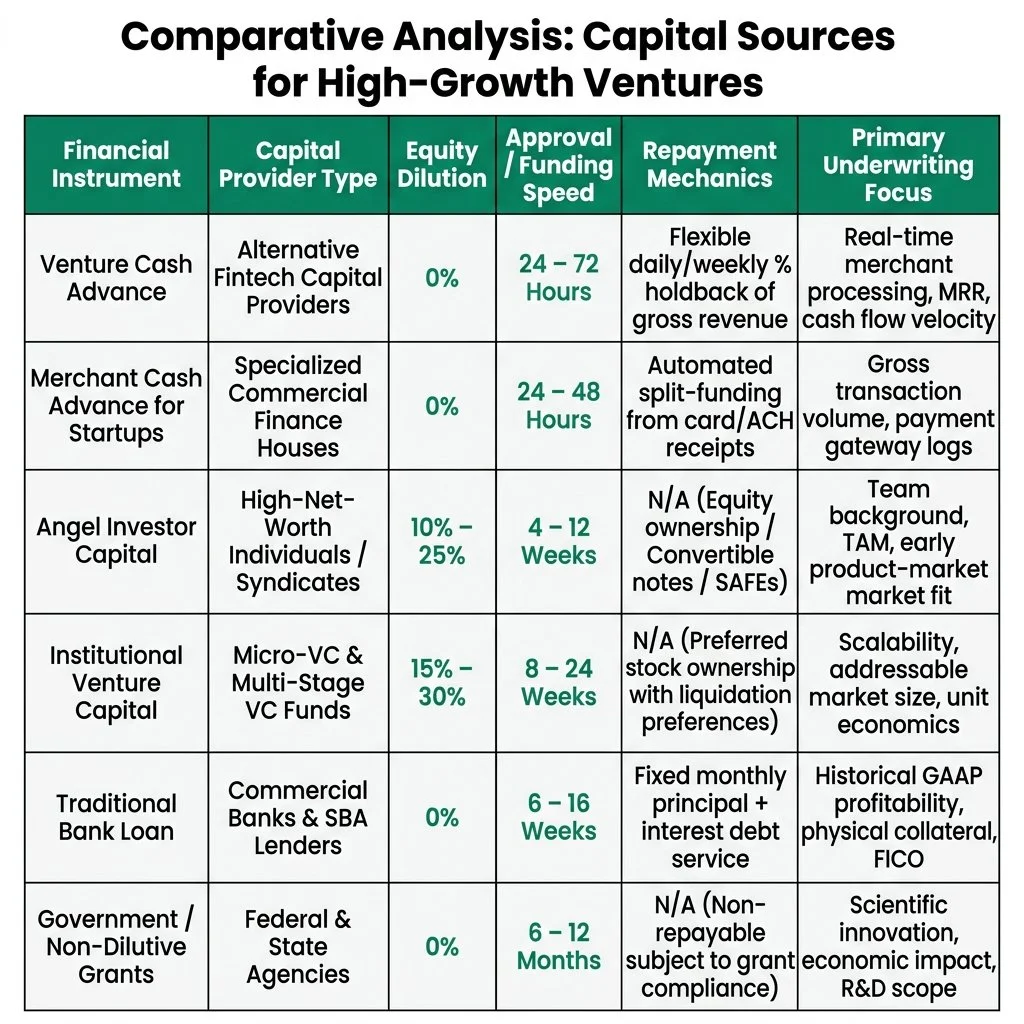
Unlike senior-secured commercial startup business loans, a cash advance structure rarely includes debt-service coverage ratio (DSCR) covenants, minimum liquidity thresholds, or board observation rights.
Key Structural Differentiators from Traditional Debt
It is essential for corporate governance teams and chief financial officers to recognize that a start up business cash advance is not a loan. Because the transaction represents a commercial purchase of future receivables, it lacks fixed monthly installments, maturity dates, and compounding interest rates.
Factor Rates vs. Annual Percentage Rates (APR): Rather than charging an annualized interest rate on an outstanding principal balance, cash advances utilize a fixed factor rate (typically ranging from 1.10X to 1.35X depending on enterprise risk and cash-flow predictability). If a venture receives an advance of $250,000 at a factor rate of 1.18X, the total remittance amount is:
Total Remittance = $250,000 X 1.18 = $295,000
Variable Remittance (The Holdback Rate): Remittances are governed by a percentage of gross processing volume—known as the holdback rate (typically 5% to 15%). If daily revenue expands, the dollar amount remitted increases, clearing the advance faster. If daily revenue contracts, the dollar amount remitted declines proportionally, protecting the operational treasury from fixed default obligations during seasonal ebbs.
Absence of Traditional Financial Covenants: Unlike senior-secured commercial startup business loans, a cash advance structure rarely includes debt-service coverage ratio (DSCR) covenants, minimum liquidity thresholds, or board observation rights.
By taking a venture cash advance, the company funds marketing initiatives immediately.
To dive deeper into the mechanics of short-term liquidity structures, review merchant cash advances: a fast and flexible funding option for your small business.
3. Strategic Fit: When Startups Should Pursue Cash Advances Over Equity
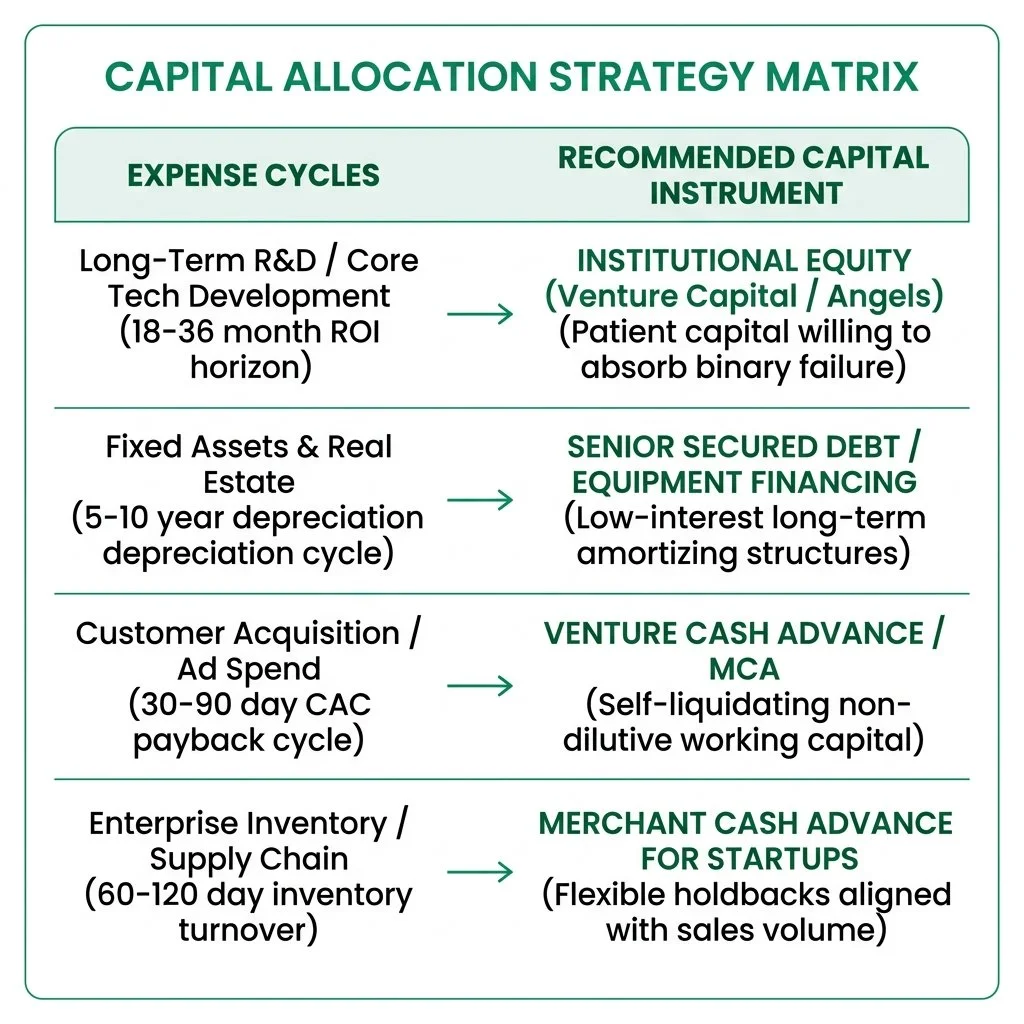
Corporate financial planning requires matching capital instruments to specific asset classes and operational expenditures. A fundamental strategic mistake made by early-stage founders is using long-term equity capital—raised from an angel investor network or institutional startup vc firms—to finance short-term operational expenses with rapid return cycles.
Securing a non-dilutive merchant cash advance for startups provides the liquidity required to hit that milestone, enabling the management team to negotiate from a position of strength with venture capital partners later.
1. Accelerating Paid Customer Acquisition (CAC)
When a software or digital venture achieves predictable unit economics—such as a 3:1 ratio of Customer Lifetime Value (LTV) to Customer Acquisition Cost (CAC) with a 90-day CAC payback period—deploying equity capital to fund media buys is inefficient.
By taking a venture cash advance, the company funds marketing initiatives immediately. The increased revenue generated from acquired customers pays off the advance holdback within months, leaving the underlying cap-table untouched.
2. Bridging Valuation Inflection Points
If an enterprise is 6 months away from reaching a critical metric threshold (e.g., crossing $5M in annual recurring revenue) that would double its valuation in an upcoming Series A round, raising equity early forces unnecessary dilution.
Securing a non-dilutive merchant cash advance for startups provides the liquidity required to hit that milestone, enabling the management team to negotiate from a position of strength with venture capital partners later.
3. Inventory and Supply Chain Scaling
Hardware and enterprise tech ventures often experience severe working capital crunches when securing large purchase orders. Manufacturing products requires upfront cash outlays months before customer invoices are paid.
A targeted start up business cash advance funds production orders immediately, matching the remittance pace with customer collection metrics.
For an extensive evaluation of funding structures across stage-by-stage tech platforms, see this detailed resource on funding solutions for scaling tech companies.
4. Navigating the Ecosystem: Angel Networks, Venture Capital, and Digital Platforms
A robust funding strategy requires blending short-term liquidity instruments with equity capital. Understanding how an angel investor vs venture capitalist evaluates your corporate structure is key to maintaining balance-sheet health.
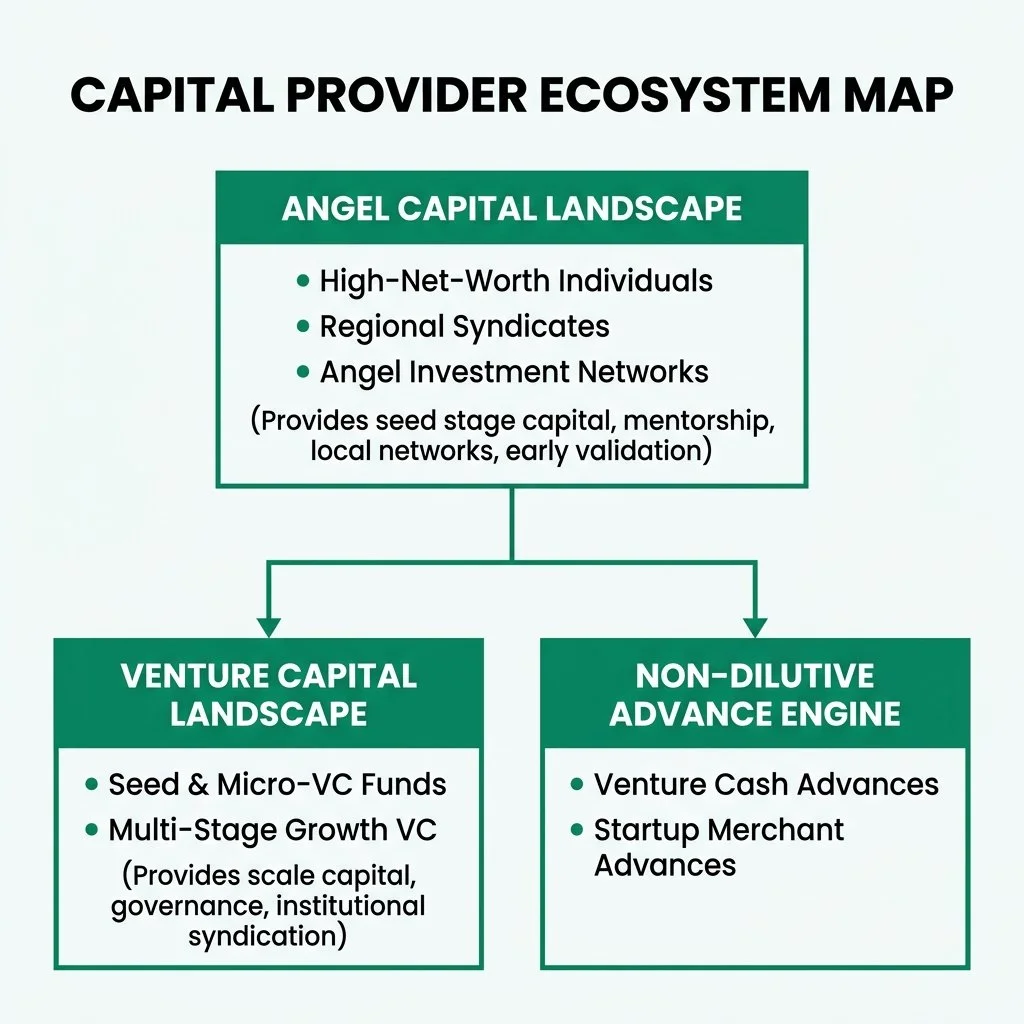
Founders seeking local strategic capital frequently search for angel investors near me or leverage an established angel investor network to assemble initial syndicate checks.
The Role of Angel Investors in Early-Stage Capital Formulation
At the seed and pre-seed stages, securing capital from an angel investor or participating in an angel investment network provides initial momentum. Unlike institutional funds, angel investors for startups often invest their own net worth based on personal thesis validation, founder conviction, and domain expertise.
Founders seeking local strategic capital frequently search for angel investors near me or leverage an established angel investor network to assemble initial syndicate checks. These investors provide patient equity that supports baseline product development.
However, when immediate growth initiatives demand fast execution, relying solely on angel checks can lead to fragmented cap tables with dozens of minor equity holders.
Synthesizing Equity and Cash Advances
The most successful treasury teams orchestrate synergy between equity partners and alternative lenders:
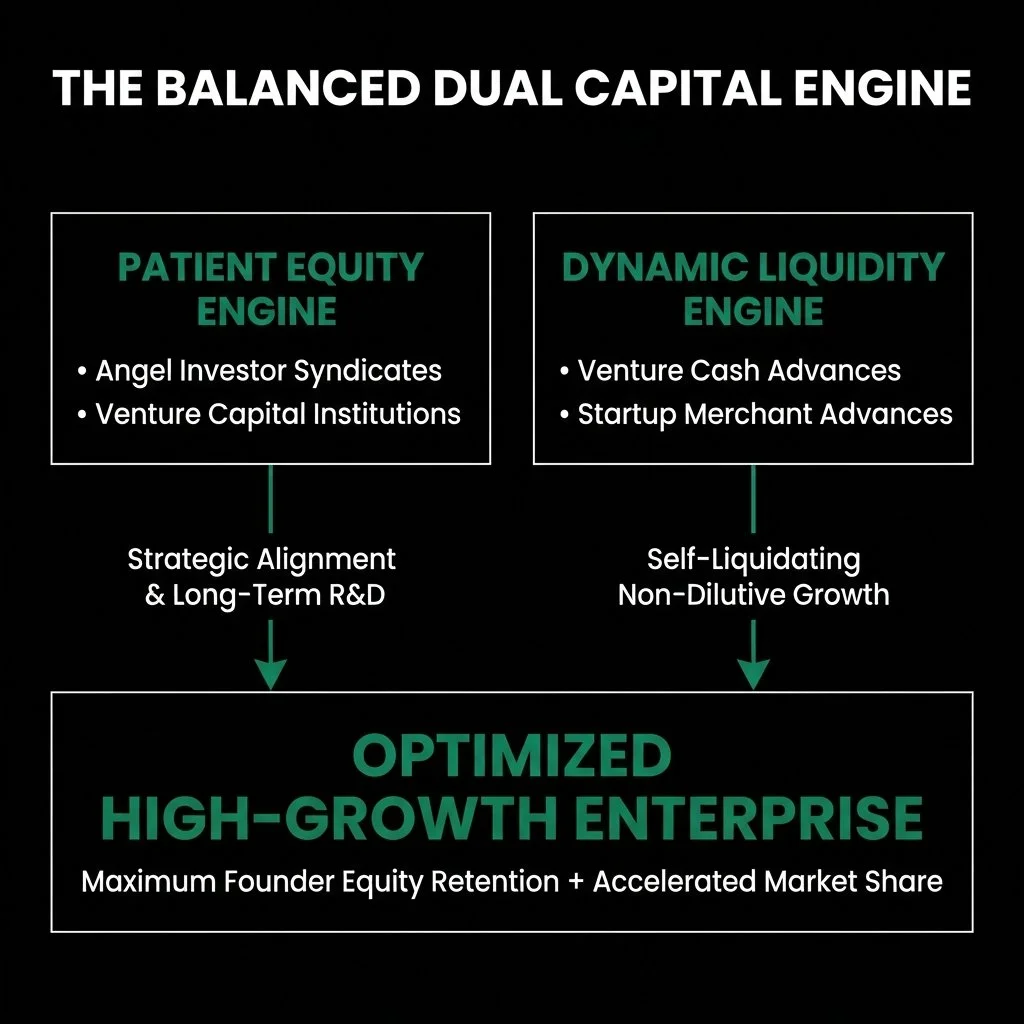
Equity Capital: Deployed into long-term assets, proprietary research and development, key executive hires, and core intellectual property.
Venture Cash Advances: Deployed into self-liquidating growth initiatives, ad campaigns, inventory buildup, and working capital buffers.
By leveraging an active startup investor syndicate for strategic guidance while using a merchant cash advance for start up business operations to manage liquidity, enterprise leaders avoid over-diluting their equity structure.
To explore accredited equity syndicates and verified funding channels, review the comprehensive 2026 guide: where can I find investors for my business and browse active corporate profiles in the Funding My Venture Investor Hub.
Furthermore, founder peer groups and dynamic digital ecosystems play an increasingly pivotal role in real-time capital formation. Active participation in structured startup forums provides management teams with peer-reviewed intelligence regarding lender reliability, factor-rate negotiations, and grant opportunities.
To connect with founder communities, read why Funding My Venture is the best online community for founders and entrepreneurs.
5. Step-by-Step Execution Guide: How to Secure a Venture Cash Advance
Securing a venture cash advance requires operational clarity and data readiness. Follow this multi-stage workflow to optimize terms, accelerate approval, and integrate cash advances into corporate treasury operations.
1.Pre-Underwriting Audit & Financial Data Hygiene:Sanitize payment gateways and bank feeds prior to submission.
Before submitting an application to alternative capital providers, audit your corporate financial data. Providers evaluate historical stability, revenue velocity, and cash flow consistency.
Consolidate Payment Processor Data: Ensure that primary processing platforms (e.g., Stripe, Adyen, Braintree, Square) have clean history without unresolved chargeback disputes or processing holdbacks.
Verify Monthly Revenue Baselines: Modern underwriters expect a minimum of $15,000 to $50,000 in monthly gross transaction volume, supported by at least 6 months of active transaction history.
Eliminate Balance Sheet Anomaly Red Flags: Resolve unnecessary overdraft events or uncollected ledger accounts that trigger automated risk flags within algorithmic underwriting software.
2.Selecting the Optimal Capital Structure & Advance Provider:Match provider terms against company CAC payback metrics.
Not all alternative finance providers operate with identical factor structures or remittance schedules.
Evaluate Factor Rates vs. Total Cost of Capital: Compare offer sheets to ensure factor rates (e.g., 1.15X vs. 1.28X) align with gross profit margins. If your gross margin is 40%, a 1.20X factor rate costs 20% of the advance, leaving margin for profit.
Determine Remittance Methodology: Choose between an automated credit card split-funding mechanism (where the processor diverts a daily percentage of sales) and daily/weekly Automated Clearing House (ACH) withdrawals directly from the primary operational bank account.
Review Early Settlement Options: Negotiate prepayment discount clauses (typically 2% to 8%) if your cash flow allows full remittance ahead of schedule.
3.API Integration & Underwriting Submission:Connect open-banking engines for real-time risk assessment.
Modern venture advances leverage digital data connections rather than paper documentation.
Grant Read-Only Open Banking Access: Connect corporate accounts via Plaid or similar secure financial protocols to permit automated risk engine scoring.
Link Billing Infrastructure: Integrate merchant processing accounts and subscription management tools (e.g., Chargebee, Maxio) to verify customer churn, net revenue retention, and expansion metrics.
Submit Supplementary Capital Stack Records: Provide details on outstanding senior debt, existing cap-table equity structure, and non-dilutive startup business grants received to give underwriters complete balance-sheet context.
4.Term Sheet Analysis & Holdback Rate Optimization:Stress-test daily holdback percentages against worst-case cash scenarios.
Upon receiving term sheets, model the operational impact of daily remittances across revenue scenarios.
Conduct Revenue Sensitivity Stress Tests: Model cash flow assuming revenue drops by 20% to 40%. Verify that remaining net cash reserves cover fixed operational overhead (payrolls, cloud hosting, office leases).
Negotiate Flexible Holdback Caps: Ensure terms include adjustments if top-line revenue contracts unexpectedly.
Examine Stacking Covenants: Verify that contract language permits stacking complementary non-dilutive instruments or raising future angel investing capital without triggering default fees.
5.Capital Disbursement & Daily Cash-Flow Monitoring:Deploy capital directly into high-ROI operational growth engines.
Once funds deposit into corporate treasury, enforce strict management controls over how liquidity is deployed.
Isolate Capital Allocation: Direct advance funds exclusively into revenue-generating channels with quantifiable ROI metrics (e.g., scaling Google/Meta media spend, accelerating production inventory).
Track Daily Remittance Ratios: Monitor daily ACH or card split deductions against gross margin receipts to maintain operational cash reserves.
Establish Re-Funding Timelines: Qualified enterprises reaching 50% to 60% remittance completion can unlock renewal options, creating a continuous working capital reserve.
For an in-depth breakdown of application criteria and underwriting requirements, read a guide to funding a merchant cash advance for startups.
6. Case Studies: High-Growth Platforms Accelerating Scale via Non-Dilutive Capital
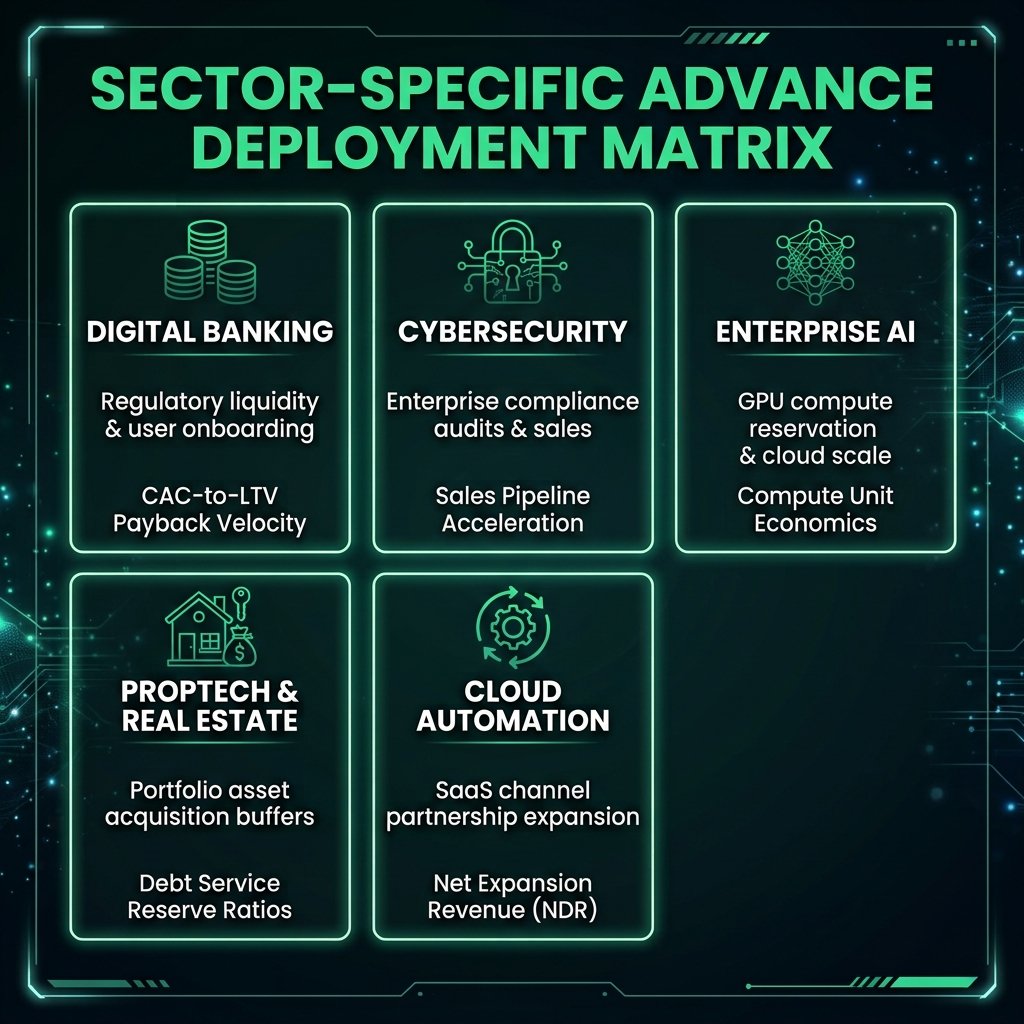
To understand how high-growth ventures deploy non-dilutive liquidity alongside institutional equity, consider these practical implementation models across major technology sectors:
By tapping into digital capital networks, management scales net retention figures ahead of Series A funding discussions with startup venture capital institutions.
1. Digital Banking & Fintech Infrastructure
Enterprises like NexBridge Digital Bank operate in capital-intensive markets where compliance, customer acquisition, and regulatory liquidity reserves are paramount. By pairing strategic seed rounds from angel investors for small business platforms with non-dilutive cash advances, fintech platforms fund marketing campaigns while preserving core equity valuation for future institutional rounds.
2. Enterprise Cybersecurity Solutions
Securing enterprise contracts requires significant upfront expenditure in SOC2 compliance audits, penetration testing, and dedicated sales engineering. Platforms such as SecureFlow Cyber Defense utilize specialized merchant cash advance for startups solutions to bridge multi-month enterprise sales cycles, satisfying client deployment requirements without taking on restrictive bank debt covenants.
3. Artificial Intelligence & Machine Learning Platforms
High-performance AI platforms like Catalyst AI Solutions face significant compute costs. Purchasing GPU cluster access and processing infrastructure requires immediate capital outlay long before enterprise subscription revenues clear. A structured venture cash advance provides immediate funding tied directly to recurring customer invoices, allowing management to scale computing infrastructure alongside market demand.
4. Property Technology (PropTech) & Real Estate Data
Real estate technology and property management platforms, such as Skyline PropTech Platform, require dynamic liquidity to support asset onboarding and regional market expansion. Deploying flexible revenue advances allows these platforms to absorb seasonal changes in real estate transactions without threatening core corporate cash reserves.
5. Cloud Infrastructure and Systems Automation
SaaS and automation platforms like Nexus Cloud Automation leverage non-dilutive capital to fund partner channel expansions and integration development. By tapping into digital capital networks, management scales net retention figures ahead of Series A funding discussions with startup venture capital institutions.
Explore active companies across these categories in the Funding My Venture Business Directory and filter specifically for high-growth tech companies in the Startups Category Hub.
7. Financial Governance & Risk Management: Avoiding Capital Distortions
While a venture cash advance provides rapid, non-dilutive capital, managing these funds requires strict financial discipline. Mismanaging revenue advances can strain cash flow and hinder corporate growth.
The holdback percentage must be capped at a level that maintains operational stability, even during low-revenue cycles.
The Hazards of Capital "Stacking"
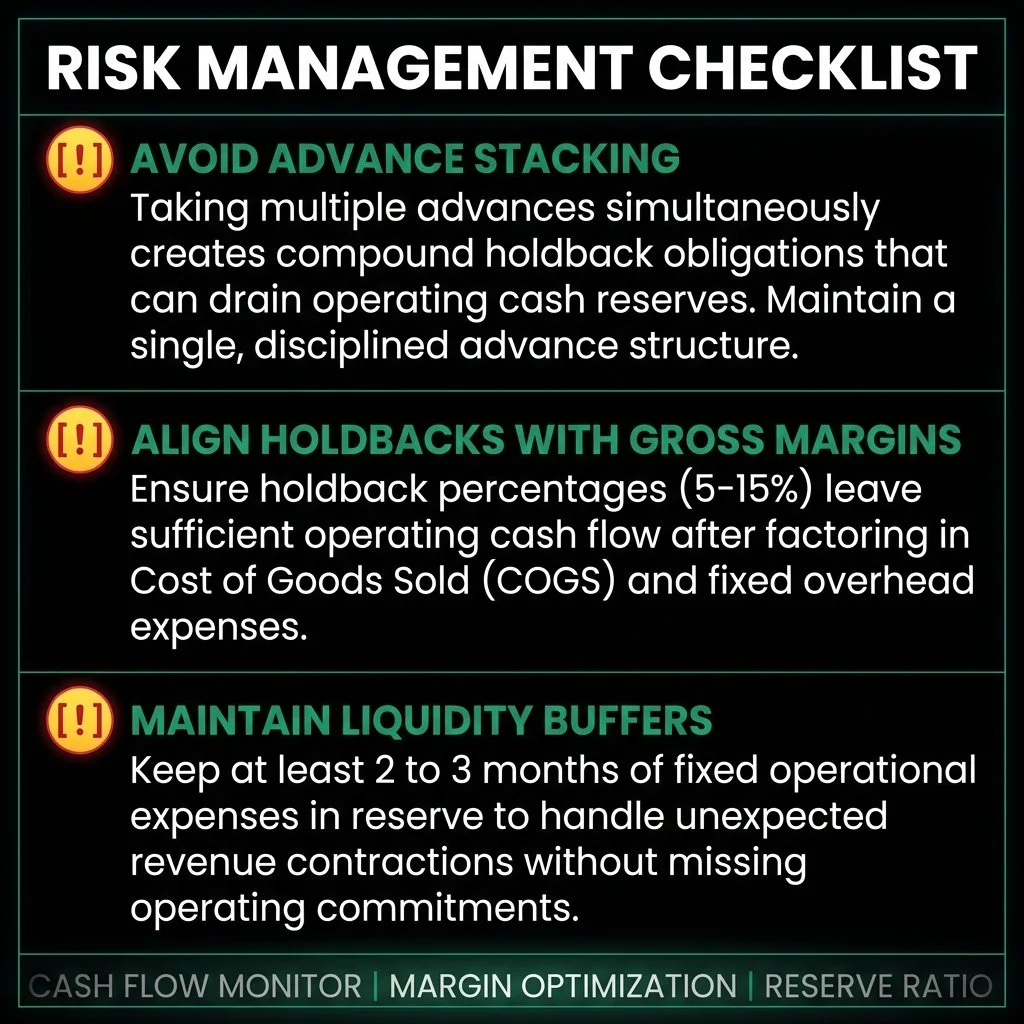
A major risk in alternative finance is "stacking"—taking out a second or third start up business cash advance from different lenders while an initial advance remains outstanding.
Because each lender takes a daily percentage holdback, stacking multiple advances can consume 30% to 50% of daily gross processing volume. This drains operating cash reserves, preventing the company from meeting payroll, paying suppliers, or covering basic operational overhead. Management should strictly prohibit stacking within corporate policy.
Stress-Testing Net Cash Margins
Before signing an advance contract, treasury teams must evaluate the net cash position after daily remittances:
Net Operational Cash = Gross Sales - COGS - Fixed Costs - Advance Holdback
If net operational cash approaches zero under normal business conditions, any minor revenue decline will force the company into a cash deficit. The holdback percentage must be capped at a level that maintains operational stability, even during low-revenue cycles.
Navigating Non-Dilutive Capital Options
When evaluating non-dilutive liquidity options, corporate leaders should consider the full range of alternative financial instruments:
Venture Cash Advances & MCAs: Ideal for short-term customer acquisition, rapid inventory scaling, and bridging operational liquidity needs.
Startup Business Grants: Excellent for zero-cost capital, though subject to lengthy review timelines and strict research scope constraints.
Equitable Capital (Angels/VCs): Essential for multi-year technology development, core hiring, and long-term strategic positioning.
8. Strategic Conclusion: Optimizing the Dual Capital Engine
As startup financing matures, the division between equity dilution and short-term debt has evolved into a balanced capital strategy. Modern technology leaders no longer view venture cash advance solutions or merchant cash advance for startups as temporary fixes. Instead, they use these non-dilutive instruments to systematically optimize their cap tables and fund predictable growth initiatives.
By applying data-driven underwriting, maintaining rigorous risk management, and deploying non-dilutive liquidity into proven growth channels, executives can scale their ventures efficiently while preserving long-term equity value.
By pairing seed-stage investments from an angel investor or angel investment network with automated working capital advances, founders protect their equity ownership. This approach ensures that when they present to an institutional startup vc at Series A or Series B, they do so with strong revenue metrics, scalable unit economics, and maximum cap-table value.
Mastering alternative capital options is essential for modern business leaders. By applying data-driven underwriting, maintaining rigorous risk management, and deploying non-dilutive liquidity into proven growth channels, executives can scale their ventures efficiently while preserving long-term equity value.